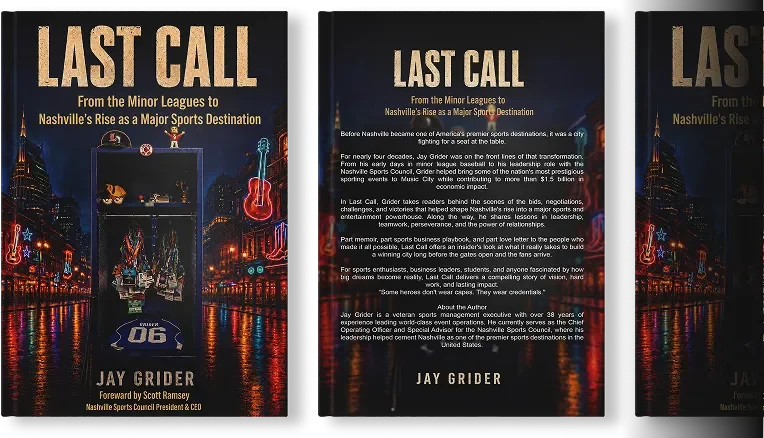
Last Call
From the Minor Leagues to Nashville’s Rise as a Major Sports Destination
Go behind the scenes with Jay Grider as determination, teamwork, and unforgettable events help transform Nashville into a nationally recognized destination for sports and entertainment.
220
Pages
06
Chapters
2805+
Sales
About Author
Jay Grider
Jay Grider built a thirty-eight-year career in professional sports, beginning in minor league baseball before becoming a central figure with the Nashville Sports Council and Music City Bowl. Working behind the scenes, he helped recruit and stage more than 200 events that generated over $1.5 billion in economic impact while strengthening Nashville’s reputation as a trusted destination for major sporting events, athletes, administrators, fans, and media across America.
Known for steady leadership, sharp judgment, and relentless attention to detail, Jay built relationships across teams, conferences, venues, agencies, sponsors, volunteers, and Nashville’s community. Last Call brings readers into the control room of that journey, blending hard-earned lessons with humor, setbacks, unforgettable characters, and the stories behind events that appeared effortless from the stands.





Featured Book
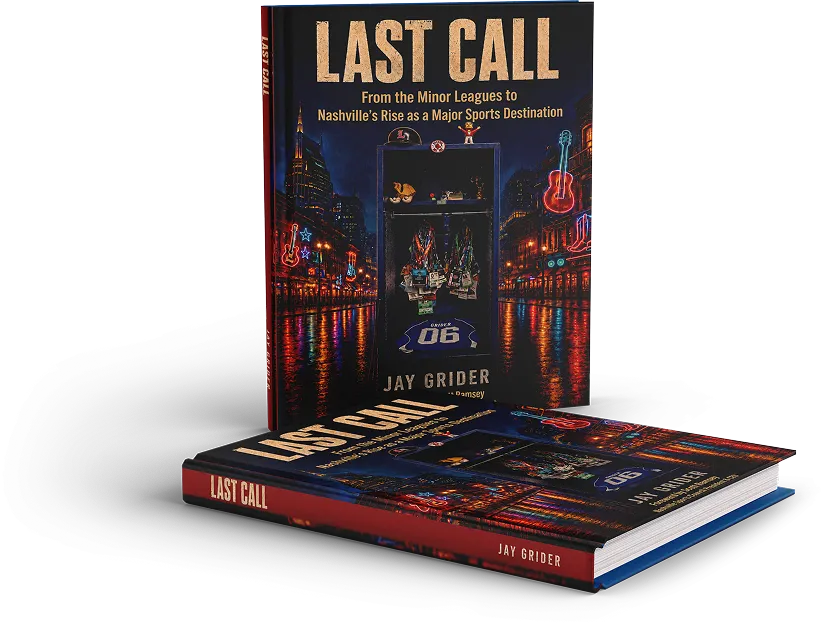
Last Call
Hybrid Memoir
Last Call takes readers behind the curtain of Jay Grider’s thirty-eight-year career, from his first break in minor league baseball to decades of shaping events through the Nashville Sports Council and Music City Bowl. Told with candor and humor, the memoir reveals the pressure, improvisation, partnerships, and persistence that made moments possible.
More than a sports story, it is a tribute to the people, relationships, and commitment behind Nashville’s remarkable rise.
Testimonials
Nashville is the Star.
I’m just the Tour Guide.
WATCH PODCAST
Inside Story
ANCEDOTAL SCROLLS
Last Call takes readers behind the curtain of Jay Grider’s thirty-eight-year career, from his first break in minor league baseball to decades of shaping events through the Nashville Sports Council and Music City Bowl. Told with candor and humor, the memoir reveals the pressure, improvisation, partnerships, and persistence that made moments possible.
More than a sports story, it is a tribute to the people, relationships, and commitment behind Nashville’s remarkable rise.
Read More
Rock and I decided to go out the back door and take a look. When we looked out at the sky, it wasn’t some Hollywood-style funnel cloud spinning out of the sky. It was a massive, green wall rolling across the Airport Road area like a tidal wave. (880 yards wide) It wound up being an F4 tornado with winds pushing 260 miles per hour. Unfortunately, there were 21 fatalities and 463 injuries. It took a direct, devastating path right through the heart of South Huntsville, hitting precisely at 4:30 PM—the absolute worst imaginable timing—catching the city dead in the middle of the evening rush hour along Airport Road. (estimated100 million in damages)
Normally, my drive home from the ballpark to my apartment was a quick eight-ten minutes. That afternoon, it took me four hours just to navigate through the rubble. Roads were littered with downed power lines and cars that had flipped upside down. It looked like a war zone. Even one car was picked up and placed on a transformer on a light pole. Shopping centers were leveled, and the entire city was thrown into an immediate state of shock and emergency response.
Back in 1989, there were no cell phones. There was no texting “I’m okay” to your family or checking a live weather radar app on a screen. When the power grids snapped across Huntsville, the entire region went completely black and silent.
Up in Shelbyville, my parents were concerned to say the least. They knew a catastrophic storm had ripped right through my backyard, and with the telephone lines dead, they had absolutely no way of knowing if I was alive or dead. My mom, thankfully, was very good friends with the Chief of Police in Shelbyville.
When she couldn’t get through to me, she called in a favor. The Chief of Police actually climbed into his cruiser, drove all the way down from Shelbyville across the state line into Alabama, and personally tracked me down in the middle of a disaster zone just to make sure I was breathing so he could report back to my mom and dad. Joe Davis Stadium survived the storm, but the city was in recovery for a long time.
MEMOIR EXTRA: When The Sky Turns Green (END OF CHAPTER 2)
“I grew up living with tornados. The first one I ever saw in person was in Arkansas when I was in the 2nd grade. It was about 200 yards away and the funnel cloud was just beginning to form. I came into the house screaming and my mom thought I was lying until she saw it herself. Growing up in Tennessee we lived through many others over the years. Well, on April 16, 1998, I got another welcome back gift courtesy of mother nature.
At the time, our offices were located right in the heart of downtown Nashville at 4th Avenue and Church Street, occupying one of the highest floors of the historic L&C Tower.
Read More
Thursday afternoon until about 3:30 PM, when the sky began to turn green. The Nashville Chamber of Commerce office was right next door. Their staff was dialed into the city’s emergency channels.
Suddenly, the phone rang. It was the assistant to the President and CEO of the Chamber, and her message was blunt: Evacuate immediately.
In any office environment, people react to a crisis differently. Some of our staff jumped up instantly, ready to move. Others hesitated, looking out the windows and questioning if there was really anything to actually worry about. Then a second, much more frantic call came from the Chamber office moments later, essentially ordering us to drop everything and move right then.
We all headed next door to the Chamber office basement. Stepping out onto the downtown streets, we could tell there was something coming. There were high winds and debris flying. As we entered the Chamber doors, a Mercedes sedan drove by us with a massive 2×4 piece of lumber completely impaled straight through its back window. The tornado itself came down Church Street right where our office was.
What had come through downtown was a F3 tornado. It jumped the Cumberland River, knocking over a massive tower crane at the Titans’ new stadium construction site before tearing through East Nashville with an estimated 133 million dollars in damages.”
MEMOIR EXTRA: Another Tornado Scare – (AFTER CHAPTER 12)
No matter how precise your timelines are or how flawless your operational checklists look on paper, you can’t account for everything.
“It all began on Saturday, April 24, 2010—the final Saturday of the month, and the exact day of the Country Music Marathon. We knew bad weather was moving in, and as the runners pushed through Metro Center, the skies went dark. Race staff made the call to cut the standard time limit down to clear the participants off the streets safely before the severe stuff hit.
Read More
Exactly one week later, over a 48-hour stretch on Saturday, May 1, and Sunday, May 2, Middle Tennessee was slammed by a deluge. On Saturday, the city received 6.32 inches of rain, shattering local records. On Sunday, it got even worse—7.25 inches fell. It was the wettest single calendar day in Nashville’s recorded history.
When the rain finally stopped, more than 13.5 inches of water had been dumped on the region in just two days. It was officially classified as a “1,000-year flood event.”
Because the ground was already heavy from the marathon weekend rains, the Cumberland River simply had nowhere to push the volume. By Monday, May 3, the river crested at a staggering, historic 51.86 feet.
For those of us who lived and breathed the downtown sports and event ecosystem, seeing the aftermath was completely surreal. Lower Broadway was literally a lake. The pristine, basement-level instrument vaults of the Schermerhorn Symphony Center were entirely submerged. And over at the stadium, the entire football field looked like a giant, murky swimming pool.
It was a massive operational crisis that caused over 2 billion dollars in damages across the city. But Nashville doesn’t stay down. We are the Volunteer State and everyone came together to get the city back on track.”
MEMOIR EXTRA: The 1,000-Year Flood (AFTER CHAPTER 29)
“In the winter of 2001, just months after the September 11th terrorist attacks, the landscape of stadium security was changing by the hour. We were implementing measures that had never been seen at a college bowl game. One of our new protocols required security to physically search every single player and staff member’s game-day bag, sealing it with a cleared wristband. To say the coaches hated it would be an understatement. Tense standoff discussions flared up at the gates as legendary coaches bristled at strangers digging through their gear. It took working hand-in-hand with traveling campus police to de-escalate the tension and explain the new reality of the world we were living in.”- Byron Schneider, Music City Bowl Security Detail
Read More
“Player orientation speeches usually put athletes to sleep, but we always made sure to give them a real-world reality check about staying smart in a major tourism hub. During bowl week, Nashville is packed with energy, nightlife, and distraction, meaning a player’s career or reputation can be jeopardized by just one late-night lapse in judgment. Years later, when a high-profile head coach sat through our security briefing, he nodded along as we detailed the protocols for managing curfews and off-field security. The coach leaned forward, grinned, and told our security chief “ : “Good. Make sure you lay it out straight for these guys. Scare the shit out of them.” -Byron Schneider, Music City Bowl Security Detail
“You want to know how deep in-state rivalries actually run? Look at the practice facility logistics during bowl week. Traditionally, visiting teams utilize Vanderbilt University’s excellent facilities to prepare for game day. But when the University of Tennessee comes to town, both programs mutually understand that some traditions are sacred. To keep the competitive boundary completely intact, UT sets up their camp elsewhere in town, and Vandy keeps their home turf exclusive. It’s a classic nod to one of the oldest rivalries in the South—proving that even during a bowl week celebration, some lines simply aren’t crossed.”- Byron Schneider, Music City Bowl Security Detail
“During our second year hosting Battle of the Bands, the weather was below freezing. Our security detail was ducking under caution tape near the stage and one accidentally ripped his trousers completely open. Unbeknownst to him, a local news crew was live broadcasting right next to the stage, leaving his entire bare backside exposed to the viewing public of Middle Tennessee while he stood at attention.” Byron Schneider, Music City Bowl Security Detail
“The deep bond of the Sports Council staff meant that every Christmas night was a family reunion as teams arrived. But Christmas 2020 broke the tradition. Instead of preparing for kickoff, Nashville woke up to the horror of the downtown Christmas morning bombing. As a senior security liaison, also serving the Nashville Predators, I was diverted from football operations straight into the smoke of the aftermath—racing to Bridgestone Arena to unlock the heavy doors and convert the stadium into a massive, multi-agency federal command center. It was a stark reminder that our sports venues are more than just entertainment stages; they are the literal fortresses that anchor the city in a crisis.” -Byron Schneider, Music City Bowl Security Detail
“Behind the scenes of a major bowl game, you have to be prepared for total volatility. One night, a starting center—drowning his sorrows after recently being served divorce papers—refused to leave the famous Coyote Ugly saloon on Broadway. When local police handsomely offered him a free ride back to the team hotel to sleep it off, the lineman declined the invite and took a swing at an officer. He spent the night in a Nashville jail cell and was promptly dismissed from the team, watching the big game the next day from the sidelines in civilian clothes.” -Byron Schneider, Music City Bowl Security Detail
“Kentucky fans and staff travel better than almost anyone, and they brought a very specific brand of enthusiasm to Nashville after a long bowl drought. For their VIP hospitality experience, the team staff arrived with several cases of authentic Kentucky moonshine. They severely underestimated the thirst of Music City. By day two of bowl week, the entire high-proof supply had run completely bone-dry, forcing an emergency logistical re-supply run all the way back across the state line to restock.” -Byron Schneider, Music City Bowl Security Detail
“Player curfews during bowl week are a logistical chess match. One night on Lower Broadway, a star player managed to slick-talk a shuttle bus driver into believing curfew had been extended by an hour. The driver announced it over the bus speaker, and the rumor spread like wildfire. When our security team realized what happened, the bus shift had changed, the replacement drivers were asleep, and the team’s starting offense was stranded on the pavement. When a panicked coach called bed checks looking for his stars, security radioed back from the neon strip: “They’re standing with me on Broadway waiting for a bus that isn’t coming.” We had to wake up a driver in the middle of the night to retrieve the offense.” -Byron Schneider, Music City Bowl Security Detail
BYRON SCHNEIDER- MUSIC CITY BOWL SECURITY DETAIL ANECDOTES.
I recently saw Barry Trotz, former Head Coach and General Manager of the Nashville Predators. We were reminiscing about the time the University of Utah played in Nashville in 2003 at the NCAA Men’s 1st and 2nd Rounds. He was at the arena and happened to walk in when Utah was having their shootaround. He was standing near the Utah Ute mascot. At some point the mascot, came over and stood near him and bumped into his shoulder. Barry, thinking it was an accident kind of moved away a bit to give the mascot some space. Soon after, the mascot bumped his shoulder for the second time. Now, he’s thinking what is this mascot’s problem?? He moves away a third time, and the mascot bumps him again!
Read More
At this point, Trotz is in hockey mode ready to drop the gloves. The mascot then removes his head and it’s Kenny Chesney! His band had been rehearsing for a tour in the arena’s rehearsal hall. Coach Rick Majerus who knew Kenny had asked him to jump into the costume”. – Barry Trotz, former Head Coach & General Manager- Nashville Predators as told by Scott Ramsey, Nashville Sports Council President & CEO.
BARRY TROTZ VS. THE UTAH YUTE MASCOT AS TOLD BY SCOTT RAMSEY
“It was August 2021, the inaugural year of the Music City Grand Prix. Part of the NSC’s scope was the Pit Stop Challenge on Broadway, where INDYCAR pit crews competed on Broadway. As part of the safety measures, water barriers were required to line the perimeter of the race area. Usually, this is something the city could help with but with it being post-COVID, resources were limited. Thus, it was on us to pick up and transport the city’s barriers. We were able to coordinate this with the Grand Prix’s tow truck company. However, the truck did NOT come with labor to load said barriers. Therefore, our staff of 10 had to physically load over fifty 100+ lbs barriers, in the August heat, onto a semi. But it doesn’t end there
Read More
we also had to unload and place them on Broadway, then load them back on to semi and unload them at the lot after the event ended. Let’s just say it was a long day and a few bruises were procured.
On top of that, filling 50 water barriers is a whole other story. I reached out to pool companies, water system companies – anyone I could think of that could fill them. I then reached out to the Nashville Fire Department and they were kind enough to fill them for us, so long as we secured water meters. It was in this moment that I learned what a water meter was. All this to say – huge shoutout to the 2021 NSC staff and Nashville Fire Department for making this event happen! Team effort all around!”- Rachel Schuchert, Former Director of Community Engagement, Events & Operations -Nashville Sports Council
RACHEL SCHUCHERT- FORMER DIRECTOR OF COMMUNITY ENGAGEMENT, EVENTS & OPERATIONS-The non-glamorous side of sports
- Have been a stage manager for the marathon. I was stuck out in Metro Center but with a very good jazz band who had played with some of the jazz greats.
- Breaking ice on the football field at Vanderbilt with other volunteers for the Music City Bowl.
- Traveling to North Alabama with a NSC staff member to recruit Youth Football Teams for the MCB on a very cold fall day.
Read More
- Coming back to the stadium after stage manager duties were over and hanging out at the volunteer tent, when a lady walks in for her volunteer shift and apologizes for being 45 minutes late because she just got through running the marathon. The next year I ran the half & thanked all the stage managers along the way.
- Enjoying conversations with Jay at the different events, early morning or late in the day.
JOHN BLACKWELL- NSC/BOWL VOLUNTEER
“In the inaugural bowl game, I worked very closely with Frank Beamer and Virginia Tech. My memory was with the ice storm and a few significant incidents. With the game being on December 29, the teams came in prior to Christmas. First off I remember being at a practice with Tech in the afternoon and having to go home and get a shower and in dress clothes for an evening event downtown. I was dressed up in a coat and tie and had on a topcoat, due to the weather. As I stepped into my driveway, to get to my car, it was a solid sheet of ice. Down I went and slid all the way to the alley. No harm and I was able to get up and head to the event. “
Read More
“The second thing I remember is, if memory serves, you called me on Christmas Eve asking me if I didn’t have friends in Gallatin? I said yes and you wanted me to try and make arrangements to use the high school practice facility on Christmas Day. After a few calls, things were arranged and the facility was set for both teams. The one thing I hadn’t thought of at the time, was we were using Metro for police escorts. I contacted Chief Turner and he said they would escort to the county line. I made arrangements with the Sumner County Sheriffs office and they assisted with the pickup at the county line, up to Gallatin and back. Everything worked out and went off without a hitch. “
“The third thing I remember is Coach Beamer asking me to run out on the field with him, to lead the team into Vanderbilt stadium. With the game being nationally televised, I received a call from family up in Ohio. They were watching the game and my great niece, who was about 4 at the time, screamed out to all in the room that “there’s my uncle Bud” when she saw me on TV!”
“Moving forward to the 2000 game, Sharon and I were riding around in a Mississippi State Troopers car with David Cutcliff. My in-laws called while we were in the Troopers car and when Sharon told them we were in a patrol car, she had some quick explaining to do! “
“Another memorable experience was 2001 and working with Boston College. Coach O’Brien was coming in with his family and needed dinner reservations. His office had called me and asked if I could make arrangements. I was able to set things up and I picked them up at the airport and got them checked into the hotel. I then took them to the restaurant and I told them to just call me when they were done and I would pick them up afterwards. They asked if I was going home to my wife and when I told them that she was out of town and wouldn’t be in until Christmas morning, they insisted that I join them for dinner. At the BC Christmas dinner Sharon and I were included at the dinner table with the O’Brien family. Both the O’Brien’s and the DeFillippo’s treated us like family. “
“One thing that really brought back a memory was that was the year it was announced that Gaylord was going to be the bowl sponsor. It was stated that both teams would stay at the Opryland Hotel. I was sitting in the hospitality room, that evening, with several of the assistant coaches. The new bowl sponsor was being discussed when one of them asked me” Bud, how will that work with both teams staying at the same hotel”? I said to him that Coach, we are at the Doubletree and Georgia is at the Renaissance. I said “it’s closer from here to the Renaissance than it is from one end of the Opryland Hotel to the other end. That experience started a friendship and when Boston College joined the ACC, Sharon and I were their guests at the inaugural ACC game against Florida State!”
“Working with Minnesota 3 out of the 4 years, of the first contract with the Big 10, also brought up a few memories. I became quite close with Glen Mason and staff. The most memorable had to be the 2005 game. When the team arrived I went to meet them. One of the first people I ran into was the teams doctor. Doc Smith noticed I was limping and asked what was wrong? I had a problem with my big toe. He examined it right away, gave it an injection and said he knew how busy I would be with my duties so he would take care of it after the game. He followed through and operated on my toe in the training room at LP Field! “
“The following season Minnesota was opening the season against Kent State. It was originally supposed to be played in Akron where they play the Pro Football Hall of Fame game. The game was actually switched to the Kent State campus. Glenn Mason had invited Sharon and I to come up an attend the game. We were given a room at the Hilton, with the team. The night of the game their chief of police, who traveled with the team, found out that Kent State had not provided any security. He asked if I would help out, so I jumped in. With the help of some of the student managers, we managed to get the team to and from their locker room without any issues!”
“Somewhere along the way, at one of the earlier games (wish I could remember which team) I was talking with one of the assistant coaches. He was trying to make sure all of his players were there for the welcome meeting. As meeting time was close to starting, he finally got in touch with a missing player.I believe he was driving in, from I think Arkansas. As the coach was talking on the phone he raised his voice and said “what do you mean you can’t find the hotel, it’s the biggest hotel in Nashville”! Then he said “you’re where”! The coach told him to get here as soon as possible. After he hung up he said “the dumb ass is in Knoxville”! The player had driven through Nashville about 3 hours earlier and he thought the game was in Knoxville! “
“One funny incident happened, when the Tommy Bowden led Clemson team came in for the 2006 game. I knew many in the Bowden family, but I had never met Tommy. I met up with him on the Mezzanine, at the Magnolia. He happened to be on the phone and a few of his assistants were there. I told them who I was and when Tommy got off the phone he stood up to greet me. At the very moment, I went to shake his hand, my phone started ringing. I thought I had it on silent but it rang out the FSU Fight Song. One of the other coaches looked at me and said “wrong Bowden”! Tommy was a good sport and was happy to know that I was friends with his dad. “
“One other experience was very dear to me. When Florida State came to play Kentucky, in 2007, I was asked to be coach Bowden’s personal driver. It was such a great experience to spend so much time with him, one on one. The day of the coaches press conference I drove him down to the stadium and back. When we got back to the hotel I walked him up to his suite and he asked me to step inside. He said he would be right back and I just stood there. When he came back he said the he wanted me to stay and visit. We sat there together talking about mutual friends and acquaintances for well over and hour and a half. “
“All and all so many of the coaches, both head and assistants, as well as team personnel have crossed paths with me over the ensuing years. I have stayed in contact with some and those who are active in the ACC, always come up and talk to me at the ACC Football Media Days.”
It’s been quite a ride for me, when I think back to when it all started in that memorable sleet game!
BUD ALDERMAN- NSC/BOWL VOL. AND LET OUT BOWL TEAM SECURITY DETAIL
“I can still very distinctly remember the radio call saying that the entrance structure at 4th and Broadway had fallen over. I’m pretty sure my response was, “I’m sorry, but what? The arch was blown over?!” The memory that overshadows this less than fun moment is how quickly we ensured no one was hurt, corrected the issue, and had a great final day for the Fan Zone on Broadway. The crowd for the concert was epic! I also distinctly remember how you had my back throughout the planning and execution process, especially as the event/budget became a much bigger animal than expected. I’m still very grateful for that support!”
COLIN MONTEMARANO, FORMER MANAGER OF STRATEGIC PARTNERSHIPS, MUSIC CITY BOWL - Fan Zone on Broadway –
ENDORSEMENTS
ENDORSEMENTS
“From the NFL Draft and NHL All-Star Game to the early days of the Music City Bowl, working with Jay has always been a privilege. His passion for people and for this city defines the Sports Council’s success. I’m grateful for the partnership and honored to celebrate his lasting impact on Nashville.”- Gordon Richard, Mayor’s Office of Film & Special Events
‘I have collaborated with Jay for 10 years. He has always been an excellent representative of the Nashville Sports Community. Jay is a problem solver and consistently uncovered ways to facilitate the growth of the Sports Entertainment experience for families from Middle Tennessee and beyond. Jay is a great communicator and a genuinely nice guy”!- Curtis Watkins, Director of Security-Associated Protective Service
“Jay Grider will always be a part of the foundation that’s allowed the Nashville Sports Council to flourish. Without his guidance, the trajectory of their success wouldn’t look the same. A great partner to work with” -Jon Cooperstein, PAC Sports
“Jay is the consummate professional and exactly the kind of person you want on your team when striving to achieve something extraordinary. He has a remarkable ability to understand what needs to be done, how to get it done, and who to bring together to ensure success. His leadership consistently creates exceptional and memorable experiences for all stakeholders involved. One of his greatest strengths is the way he consistently leads with class, compassion, and sharp wit, making him one of the most trusted—and enjoyable—colleagues to have by your side when challenges arise.”-Byron Hatch, Chief Operating Officer, CFP
“Jay is nothing but a first-class individual, and in every step he and Clemson crossed paths, Jay treated everyone at Clemson like a long-time friend. No matter whether it was hourly, daily, weekly or annually, at every moment, he was the best activist for the City of Nashville and the Nashville Sports Council that anyone could ask for and made our two visits to bowl games a true joy. To this day, Jay remains a great friend to Clemson and a fantastic advocate and ambassador of the community.” – Tim Match, Senior Associate AD/Chief Revenue Officer, Clemson University
I don’t recall exactly when we first met it has been a few years now but I can truly say it has been such a joy working with Jay. We’ve shared so many wonderful moments, conversations, and laughs at SEC games and networking events. It has been a pleasure and he will be missed. I wish he and Victoria nothing but the best in their next chapter!
-Tina Tackett, Sales & Event Manager, The Palm Restaurant-Nashville.
BLOGS
BLOGS

From Rejection Letters to a Career in Professional Sports
Jay Grider’s journey began with persistence, one unexpected phone call, and a willingness to handle every task the game demanded.

How Nashville Earned Its Place as a Major Sports Destination
Decades of planning, partnerships, and dependable execution transformed Music City into a trusted home for nationally recognized sporting events.

What Fans Never See Behind a Successful Sporting Event
Smooth events are built through careful preparation, quick decisions, strong relationships, and teams ready to solve problems before spectators notice.

The Ice Storm That Tested the First Music City Bowl
Nashville’s inaugural bowl game faced frozen roads, practice challenges, and intense pressure, yet teamwork kept the new tradition moving forward.

The NFL Draft That Proved Nashville Was Ready
Record crowds, national attention, and years of preparation showed that Nashville could confidently manage football’s largest public celebrations.

Leadership Without the Spotlight in Nashville Sports
Jay Grider’s legacy reflects mentorship, humility, trusted partnerships, and the countless people whose unseen work made major events possible.